
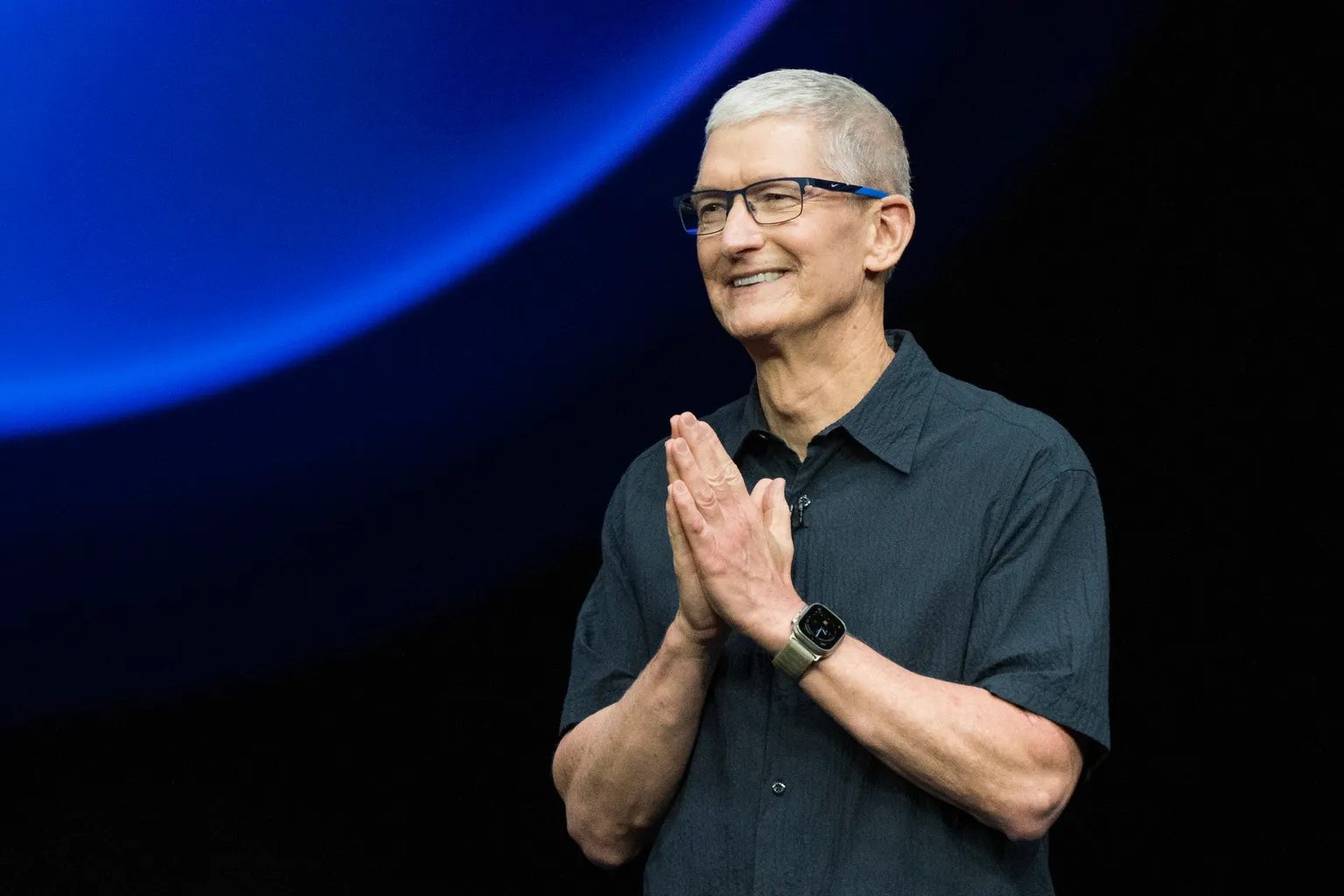
The End of an Era
On April 20, 2026, Apple announced Tim Cook's departure with minimal fanfare—"eleven sentences" for a company he transformed from a $350 billion enterprise into a $4 trillion empire. Cook exited characteristically: "without spectacle, without sentiment, and without leaving anyone quite sure whether to call it a triumph or a warning."
John Ternus inherits a financial powerhouse facing critical decisions about AI, spatial computing, and the next technological frontier. The stakes differ from those when Jobs returned in 1997 or when Cook took over in 2011—they are higher, the competition fiercer, and the competitive window increasingly narrow.
The Operator
Cook became CEO on August 24, 2011, hired originally by Jobs from Compaq in 1998 for operational expertise, not visionary thinking. He transformed Apple's chaotic supply chain and quietly managed the company during Jobs' medical absences.
Under Cook's leadership, revenue grew from $110 billion in 2011 to $416 billion by 2025. Apple achieved unprecedented market milestones: $1 trillion in 2018, $2 trillion in 2020, $3 trillion in 2022, and $4 trillion in 2025. His approach was execution-focused rather than imitative.
The Builder
Cook introduced product categories Apple didn't originally occupy. The 2014 Apple Watch captured 32% of the global smartwatch market. AirPods, initially dismissed as design jokes, became the world's most popular headphones, with Apple and Beats combining for roughly 40% of global wireless headphone retail revenue.
Services revenues were quietly assembled from existing pieces: iCloud, the App Store, iTunes evolving into Apple Music, Apple Pay, Apple TV+, and Apple Arcade. By Q4 2025, services gross profit exceeded iPhone's for the first time: "42% against 41%, at margins of 75%."
Apple's custom silicon strategy proved transformative. The M1 chip launched in November 2020 demonstrated unprecedented performance-per-watt ratios. Mac market share grew to 9% globally by 2025, with the United States seeing nearly 1 in 3 personal computers running macOS. The MacBook Neo, starting at $599 with flagship performance, exemplified Cook's final strategic vision.
The Diplomat
Cook understood Apple's role as geopolitical actor with sophistication few peers matched. He attended Trump's 2025 inauguration, committed to a $500 billion US investment plan, and secured tariff exemptions for Chinese-manufactured iPhones. Regular Beijing visits made him a "corporate strategic asset" protecting Apple's China operations.
Cook navigated regulatory battles across continents—EU Digital Markets Act, US antitrust cases, privacy legislation, and political divisiveness—without making Apple the villain in inescapable scandals. Remaining as Executive Chairman allows him to continue absorbing diplomatic and regulatory burdens.
The Reckoning
Cook's tenure included notable missteps. AirPower, announced in 2017, was cancelled in 2019 without shipping—Apple's first public un-announcement. Apple Maps launched catastrophically inaccurate, prompting Cook's public apology. Both signaled "his instinct for caution occasionally tipped into shipping things before they were ready."
Project Titan consumed roughly a decade and "$10 billion in R&D" before quiet cancellation in 2024—ironically as Chinese competitors expanded into electric vehicles. Apple Vision Pro arrived at $3,499 with "extraordinary hardware, no killer application and a price unreachable for any mass market."
The most damaging failure involved artificial intelligence. After ChatGPT's November 2022 debut, "Cook had not provided the internal resources required to build a competitive large language model." Siri, the industry's first mainstream voice assistant, became structurally outpaced over fifteen years. When Apple responded at WWDC 2024, gaps remained unfilled. Apple ultimately licensed "Google's Gemini to power tools it had advertised as its own."
Jony Ive, the designer behind iMac, iPod, and iPhone, sold his startup to OpenAI for $6.5 billion and joined Apple's most formidable AI competitor.
The App Store's 30% commission faced simultaneous legal challenges from the EU Digital Markets Act, US Department of Justice antitrust action, and multiple international regulators, threatening Apple's margin engine.
The Engineer
John Ternus was born in 1975 and joined Apple in 2001 designing the Cinema Display. Before Apple, he spent four years "designing virtual reality headsets at Virtual Research Systems," gaining critical exposure to cutting-edge display technology. His University of Pennsylvania senior project involved "a mechanical feeding arm for quadriplegic patients operated by head movement," illustrating his human-centered design philosophy.
Promoted to Senior Vice President in 2021, Ternus led engineering across iPhone, iPad, Mac, AirPods, Apple Watch, and Vision Pro. He directed the Mac's transition to Apple Silicon and championed the MacBook Neo. Cook described him as possessing "the mind of an engineer, the soul of an innovator, and the heart to lead with integrity and honor."
The Inheritance
Ternus faces an incomplete inbox: the AI gap, where Siri remains outpaced after fifteen years; Greater China revenue falling 3.6% year-over-year in 2025 amid Huawei's aggressive recovery; the App Store's 30% commission under legal siege; and Vision Pro's lack of mass-market justification despite technical excellence.
Advantages include Apple's custom silicon moat, two billion active devices as distribution infrastructure, a services engine running at 75% margins enabling strategic patience, and Cook's continued board presence absorbing geopolitical battles.
The MacBook Neo signals Ternus's direction—lower price points extending Apple's reach into traditionally uncontested segments. Vision Pro's commercial failure represents "raw material" feeding into successor form factors, likely glasses arriving sooner than expected.
"An engineer may, in the end, be exactly the man for it"—potentially poised to recognize that Apple's competitive advantage lies in patient execution rather than chasing every technological trend simultaneously.